Your cart is currently empty


With summer in full swing, every day presented an opportunity to take advantage of the sun’s golden rays as they lazily drifted toward the horizon.
On this particular evening, there was a ruckus along the river; someone was clearly voicing their discontent. Slowly, I crept toward the source and spied a Spotted Sandpiper (Actitis macularius), the most abundant breeding sandpiper in North America, chattering away. My camera immediately went to work, and I snapped a few backlit photos as it sprinted along the shoreline, occasionally flying to the opposite bank and back again.

Eventually, the bird calmed down and landed on a nearby bush. Nevertheless, it was still on high alert, scanning the horizon for threats and keeping me square in its sights.

Suddenly, there was more movement along the ground — wait — what was that? Two skinny, long legs topped by a little puffball and graced with the tiniest sharp beak sprinted by — too quickly to commit to the camera.
Ahhhh — the lightbulb came on. The adult sandpiper was a parent! This explained the extreme agitation and protective stance. As I later found out, its beautiful plumage should also have been a clue since Spotted Sandpiper chest feathers only sport those spots during breeding months.
Sigh, I could not obtain photographic evidence of the juvenile that night.
Three days later, I gleefully returned to the same spot and quietly planted myself on a log. Sure enough, the parental sandpiper unit was flitting about, reconnoitering the area before letting the offspring wander. This time, it seemed less suspicious of me, although still periodically glancing in my direction.
Before long, the puffball came running by. Like a human toddler, it was full of energy and appeared happy to have left behind the confines of its nest.

I giddily watched it for about thirty minutes and, this time, was privileged to capture the youngster “on film.”

Silly me — I had assumed the mom was looking after the chick. However, upon googling the species, I discovered their gender roles are frequently reversed. Unlike their cousins, the Common Sandpiper, female Spotted Sandpipers may be, shall we say, polyamorous, or in bird-speak, polyandrous.
This means they will mate with multiple males each year, provided they can best their competition.
A female can potentially lay up to five complete clutches of four eggs each during a breeding season. The incubation takes around three weeks, so hatching and raising more than one brood would be a struggle.
Instead, the females leave their partners responsible for birthing and child-rearing. These feminist badasses are also the ones to arrive early to secure territory and defend it.

In the cases where the females are monogamous, they do feel compelled to pitch in and help with raising the children occasionally.
After learning all this and realizing that male and female sandpipers are very similar in appearance, I was still uncertain about whether I was dealing with the mom or dad. But for all intents and purposes, it made sense to assume that Papa Teeter-peep was in charge here.
Teeter-peep, teeter-bob, jerk or perk bird, teeter-snipe, and tip-tail are all apparently nicknames for the Spotted Sandpiper. Their characteristic teetering motion has earned them these monikers.
Oddly, though, that bobbing motion’s function has not yet been identified. Chicks will apparently teeter almost as soon as they hatch, and the teetering increases when the birds are nervous. But this behavior is not used for courting, aggression, or expressing alarm. To be honest, I did not observe any teetering during my time with the sandpipers, even on the occasion when a curious Northern Flicker came for a visit.

As an aside, their taxonomic name, Actitis macularius, stems from the Greek word for “coast-dweller” and the Latin word for “spotted.”
It had been five days since my first visit, and the baby sandpiper was becoming more independent, venturing further and further during exploration.

That evening, to my surprise, a second chick debuted, though clearly not as steady as its older sibling and much more shy. This made it impossible for me to get any good images; they all ended up in the trash bin.
Another shock was that Father Sandpiper had apparently decided that I was competent enough to babysit for him. With barely a goodbye, he flew off for half an hour of freedom.

I did not take this responsibility lightly and kept my eyes peeled on my charges to the best of my ability until he finally returned from his well-earned respite.
During my fourth foray to Sandpiperville, I again heard a loud commotion. I hurried to find out what the kerfuffle was about and barely had time to pull out my camera as a large garter snake slithered away from an obviously distraught parent.

Even though snakes are not officially listed as predators for Spotted Sandpipers, in this case, there was obviously the fear that one of the youngsters could end up as a meal (the blob in the lower right-hand corner of the photo is actually a chick). Thankfully, the snake was not in the mood to tussle, and the family was left intact for the day.
The whole ordeal had left the parent shaken, though, and it was much more vigilant thereafter. Moreover, my short-lived stint as a sandpiper babysitter was over, which was a relief.
As I mentioned, daddy sandpiper became much more cautious after the snake incident. At one point, a couple with an unleashed dog came too close for comfort, and his parental instincts sprang into action once more. He called his chicks, and the younger one came running pretty quickly. It then buried itself under Papa, creating a four-legged sandpiper of sorts.

The older sibling took a few minutes to arrive and only reluctantly took advantage of the downy refuge, first attempting to burrow into the wrong side before realizing it was already occupied.

Eventually, it got to the right spot and hunkered down.
They were so well hidden once they were safely ensconced that a passerby would have been hard-pressed to notice them.

For several minutes, their pop scanned the area for dangers before concluding that all was safe. Naturally, both chicks took off exploring again as soon as they were released.

I also took leave of the family, planning to come again the next day.
Despite my good intentions, I did not return to their territory until four days later.
It had now been nine days since I first met the Sandpipers, and this was my fifth visit. The younger chick was becoming much sturdier and stretching its teeny-weeny wings.

And the older one had turned into a typical full-fledged teenager.
This became evident during the next fire drill when the youngster took over five minutes to respond to dad’s frantic calls. Once it arrived, it briefly huddled under the parental wings before rebelling and taking off once more.

The babies were growing up!
I had no idea this would be my last visit with them. We had a trip coming up, but I thought I would be able to squeeze in a final goodbye. Alas, it was not to be.
My final images were of the two youngsters confidently striding out into the world.


Whether or not the two young sandpipers will reach breeding age is anybody’s guess, but based on the research, their chances are declining yearly, as are those of nearly all birds.
According to the State of the Birds report from 2022, three billion birds, or twenty-five percent (25%) of breeding populations, have been lost from the United States and Canada in the past fifty years.
Those are staggering numbers.
Despite being widespread, our Spotted Sandpiper is included in that trend as a common bird in steep decline.
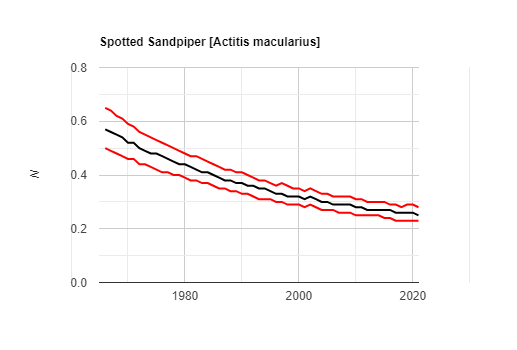
Aside from climate instability, factors affecting their population include the development and loss of wetland habitats and compromised water quality resulting from pesticides, herbicides, or other runoff.
What do these numbers have to do with us? Everything, in fact. Birds are harbingers of the extinction crisis, and humans face the same threats.
The State of the Birds report is a clarion call for us all to help address the wildlife crisis …
— Corina Newsome, associate conservation scientist, National Wildlife Federation, from www.nwf.org/en/Latest-News/Press-Releases/2022/10-12-22-State-of-the-Birds-Report
Essentially, the health of all species is interlinked, and we must do better at protecting the biosphere that makes life possible on our planet.
What affects birds affects us, and birds are telling us they are in trouble. The State of the Birds Report underscores both the serious threats facing birds as well as opportunities to forge solutions that will benefit birds and the places they need…Ensuring healthy landscapes across our forests, grasslands, wetlands, and more will help protect birds and people alike by storing carbon, providing essential habitat, and building more climate-resilient communities.
— Marshall Johnson, chief conservation officer, National Audubon Society, from https://www.audubon.org/news/2022-us-state-birds-report-reveals-widespread-losses-birds-all-habitats-except
In other words, what’s good for the goose is good for the gander. Or, in this case, what’s good for the sandpiper is good for the human!
Without awareness, there can be no empathy; without empathy, there is no action. If this story resonates with you, please consider sharing it to raise awareness of the biodiversity crisis.

As an insider, you'll get early access to new images, conservation stories, and special offers—plus our exclusive 3-pack of Hummingbird Wallpapers!
We’ll send you a confirmation email. If you don’t receive it within a few minutes, please check your SPAM folder!
P.S. Don’t worry – we promise not to flood your inbox, and you can unsubscribe anytime.
*Did you know that the term Charm may be used to describe a collection of hummingbirds?